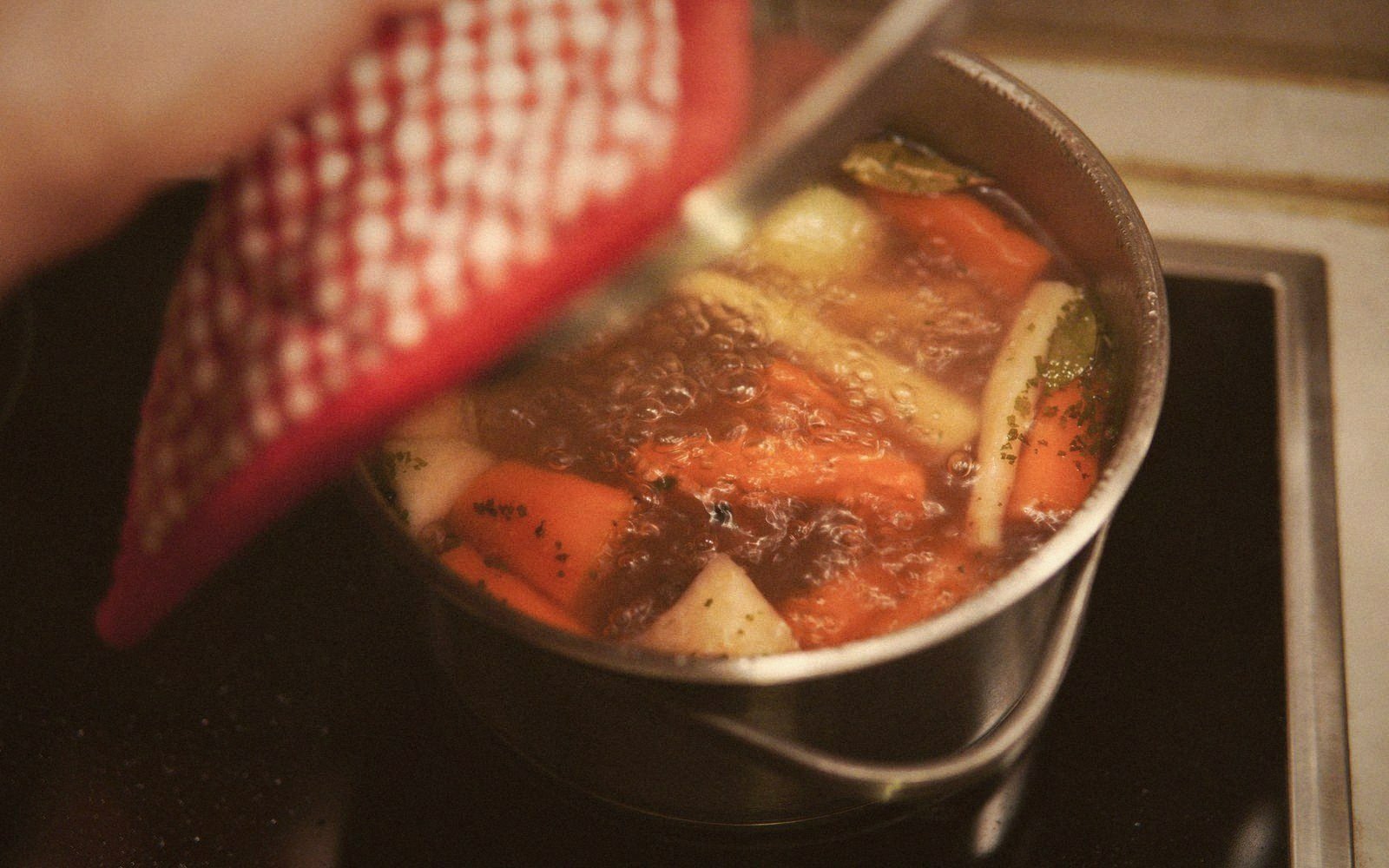
What a stock is actually doing
A stock is an act of extraction. You are not cooking the bones and vegetables in any meaningful sense — you are using hot water as a solvent, drawing out dissolved proteins, mineral compounds, and above all the collagen locked inside connective tissue and cartilage. Collagen, when held at sufficient heat for long enough, converts to gelatine. That gelatine is the whole point: it gives a finished stock its body, its slightly viscous texture, and the quality that makes a sauce cohere on a plate rather than pool around it.
This is why bones matter more than meat, and why the bones worth choosing are the ones with the most collagen-rich material attached: veal knuckles and feet, chicken carcasses with their cartilage still intact, the trotters and snouts that turn up cheaply in a market charcuterie stall. A broth made mostly from lean meat will taste agreeable but will not set when chilled; a proper stock made from the right bones will firm to a trembling jelly overnight in the refrigerator. That jelly is proof of extraction done correctly.
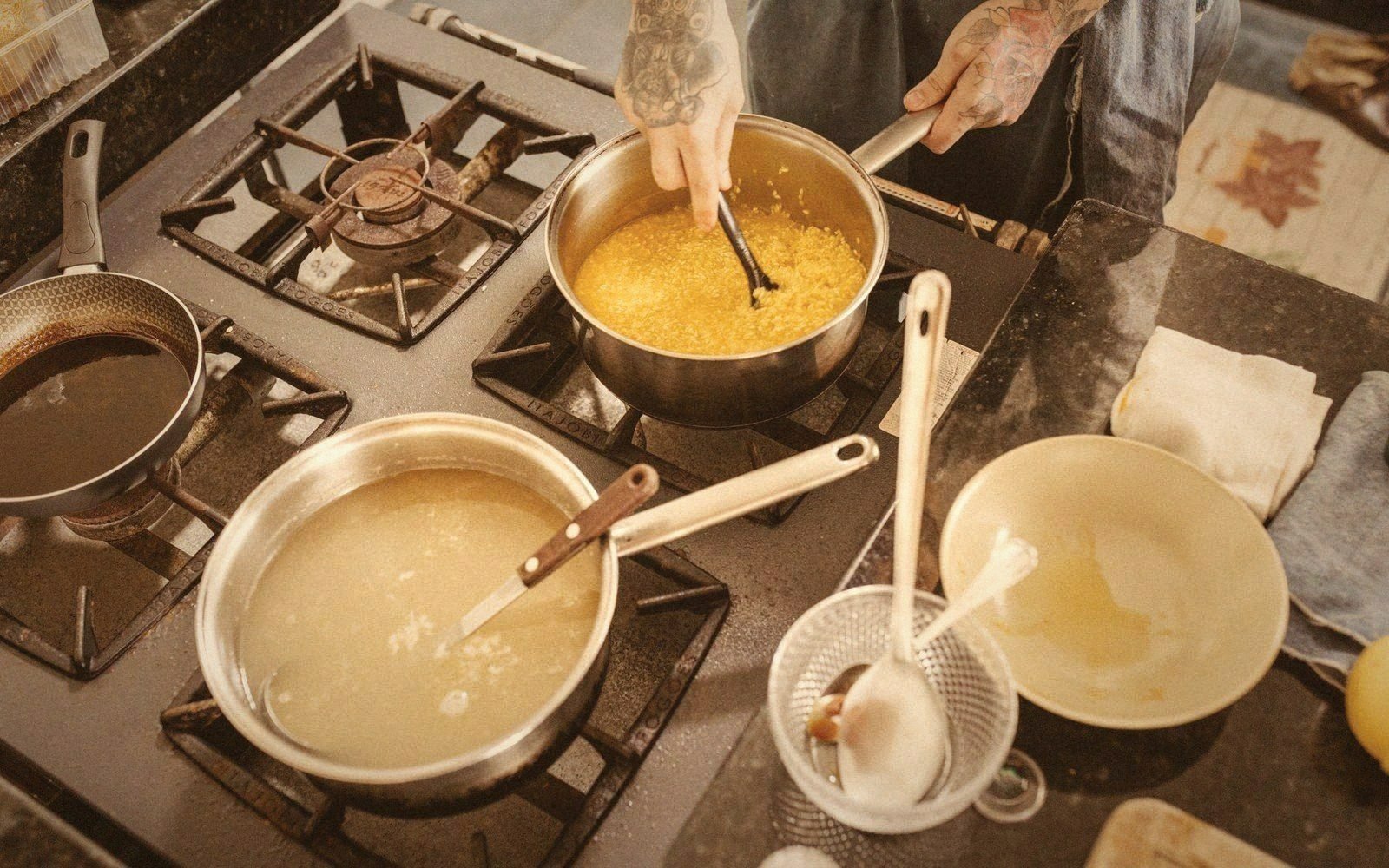
The aromatics — onion, carrot, celery or celeriac, a bouquet garni of bay, thyme and parsley stalks — are not there to make the stock taste like a vegetable soup. They are there to round and suppress the rangy, almost aggressive quality that bones and blood produce on their own. They contribute relatively little of the final character compared to a long, slow leaching of the bones themselves. For the same reason, aromatics go in only partway through a long stock — a veal fond brun (brown stock, made from roasted bones) might cook for six hours, and you add the vegetables only in the final two. Boil them for six hours and they turn acrid.
Temperature is the whole game
Here is where most home cooks lose control: they bring the stock to a boil, drop it to what they think is a simmer, and leave. But there are two very different things the pot can be doing and they produce two different liquids. A true simmer — around 85 to 90 degrees Celsius — produces the occasional bubble breaking the surface, perhaps one or two a second at most. At this temperature, the liquid is extracting efficiently; the proteins that cloud it are rising to the surface in a grey foam that is easy to lift away with a spoon; the fat is floating in distinct droplets rather than being driven into suspension.
A boil, even a gentle rolling boil, does something entirely different. The agitation beats fat into the liquid in tiny droplets — exactly what you do deliberately when making an emulsion — and beats the denatured proteins through it too. The result is opaque, grey-beige, and flat-tasting. The fat coats your palate rather than staying coherently above the waterline where you can remove it. You can eat this liquid; it is not harmful. But it is not stock. It is something closer to a cloudy, greasy broth, and no amount of subsequent skimming will recover what has already been dispersed through it.
The old instruction to skim fréquemment — frequently — exists for exactly this reason. In the first thirty minutes over moderate heat, as the liquid climbs toward its working temperature, a substantial quantity of grey foam rises. This is coagulated blood protein, the same material that makes a roast's juices run brown when rested. It will cloud your stock permanently if left in. Skimming it off while it is still gathered on the surface costs four minutes; ignoring it costs the clarity of everything that follows. After that first foam passes, skimming is less urgent — every twenty or thirty minutes is enough — but it is never finished. Fat accumulates steadily throughout the cook.
Why the lid stays off
The lid question sounds trivial and is not. A covered pot retains steam; retained steam keeps the liquid level up and the temperature even. These sound like advantages. But a covered pot also traps the volatile compounds rising off the stock — some of which are off-flavours you want to lose, and some of which condense back into the liquid and contribute to that slightly muddy quality that separates an adequate stock from a clean one. More practically, a covered pot on a domestic burner will almost always push past a true simmer. Left unattended, it boils. An uncovered pot cools naturally at the surface, steadies itself, and lets you see at a glance whether the temperature has crept up.
There is a further, practical reason to leave the lid off: reduction. As water evaporates through the cook, the stock concentrates slightly — not dramatically over a four-hour chicken stock, but enough to deepen the flavour. This is not incidental. Fonds de cuisine, the classical kitchen's foundation stocks, were always intended to be reduced further into demi-glace (stock reduced by half or more to a syrupy, intensely flavoured concentrate) or glace de viande (reduced all the way to a dark sticky coating on the spoon). The uncovered pot has been doing its own quiet concentration the whole time.
Starting cold, finishing clear
One last point that separates a clear stock from a cloudy one: start with cold water. Putting bones into cold water and raising the temperature slowly allows the proteins to coagulate gently and rise, rather than seizing immediately and dispersing through the liquid. Many cooks also blanch bones first — covering them with cold water, bringing to a boil briefly, then draining and rinsing before starting the proper stock — to remove the most aggressive blood proteins before the long cook begins. With a chicken carcass this step is optional; with veal bones, which carry more blood, it is worth doing.
A finished stock should be strained through a fine-meshed sieve — a chinois (conical metal strainer) is the traditional tool — without pressing the solids. Pressing forces cloudy liquid through. Patience here costs nothing. Chill the strained stock quickly, and the next morning the fat will have formed a solid disc on top that lifts cleanly away. What remains beneath should be clear, dark or golden depending on the bones, and firm enough to hold its shape when a spoon cuts through it. That is the evidence that the temperature stayed where it belonged, that the lid stayed off, and that extraction was given the time it required.