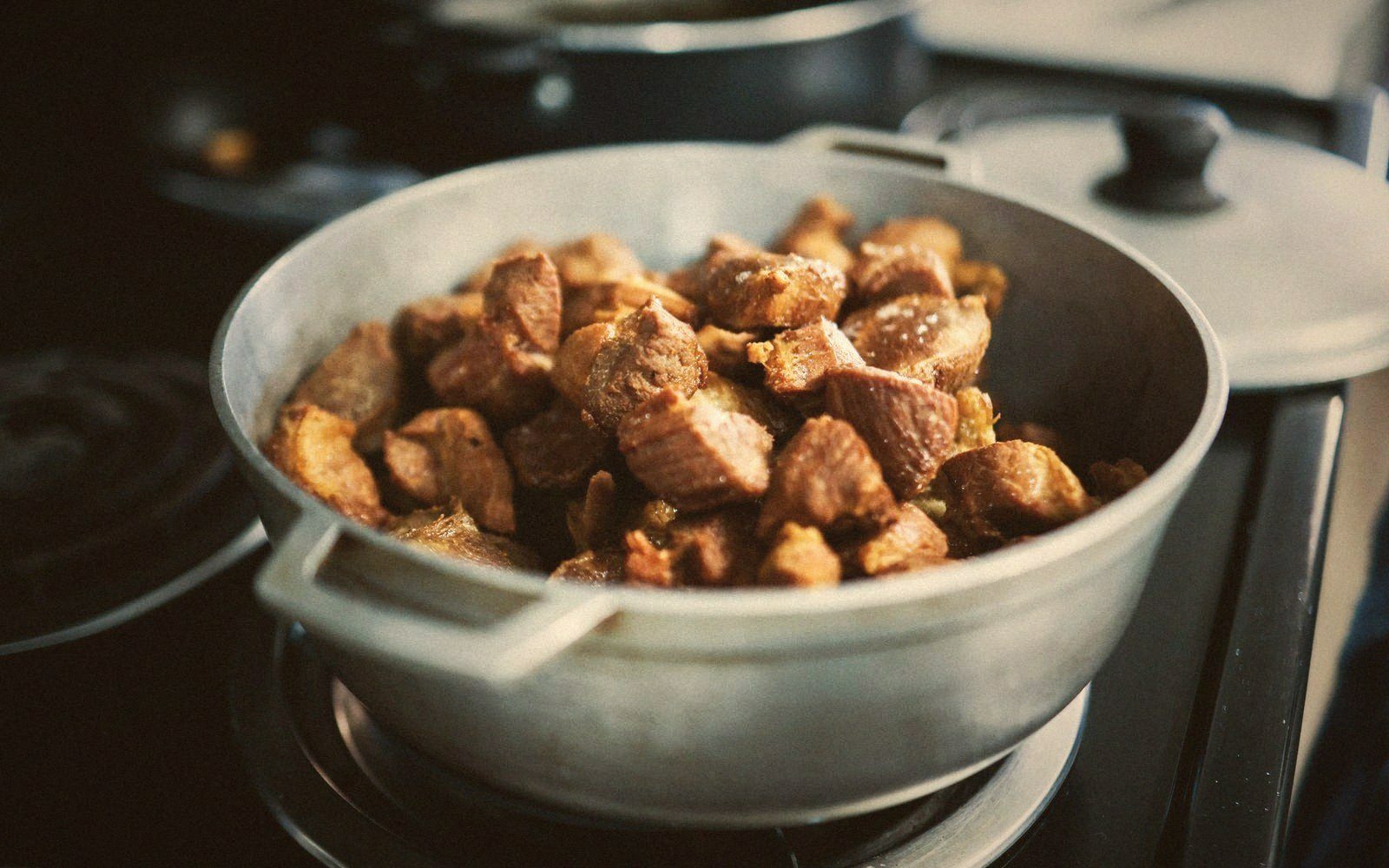
Why the Hard Cuts Win
Braising is a transaction between time, heat and collagen. Collagen is the protein that holds muscle fibres together in connective tissue — tendons, silverskin, the cartilage webbing that runs through a cheek or a shin. In a dry, fast heat it stays tough. Hold it between roughly 70 °C and 80 °C in a moist environment for long enough and it hydrolyses into gelatine: soft, unctuous, capable of coating a spoon and — once cooled — setting the braising liquid to a trembling jelly. That transformation is the whole point of the method. A fillet has no collagen to speak of; it cooks quickly because there is nothing to convert. The shoulder, the shank, the cheek, the oxtail — these are the cuts that did the most physical work in the animal's life, which is precisely why they are worth the time.
The French domestic kitchen has always understood this by necessity. Bœuf bourguignon runs on chuck or blade; daube provençale on shin; joues de porc — braised pork cheeks — were never a restaurant invention. The cuts were cheap because they were demanding, and the braise was the answer.
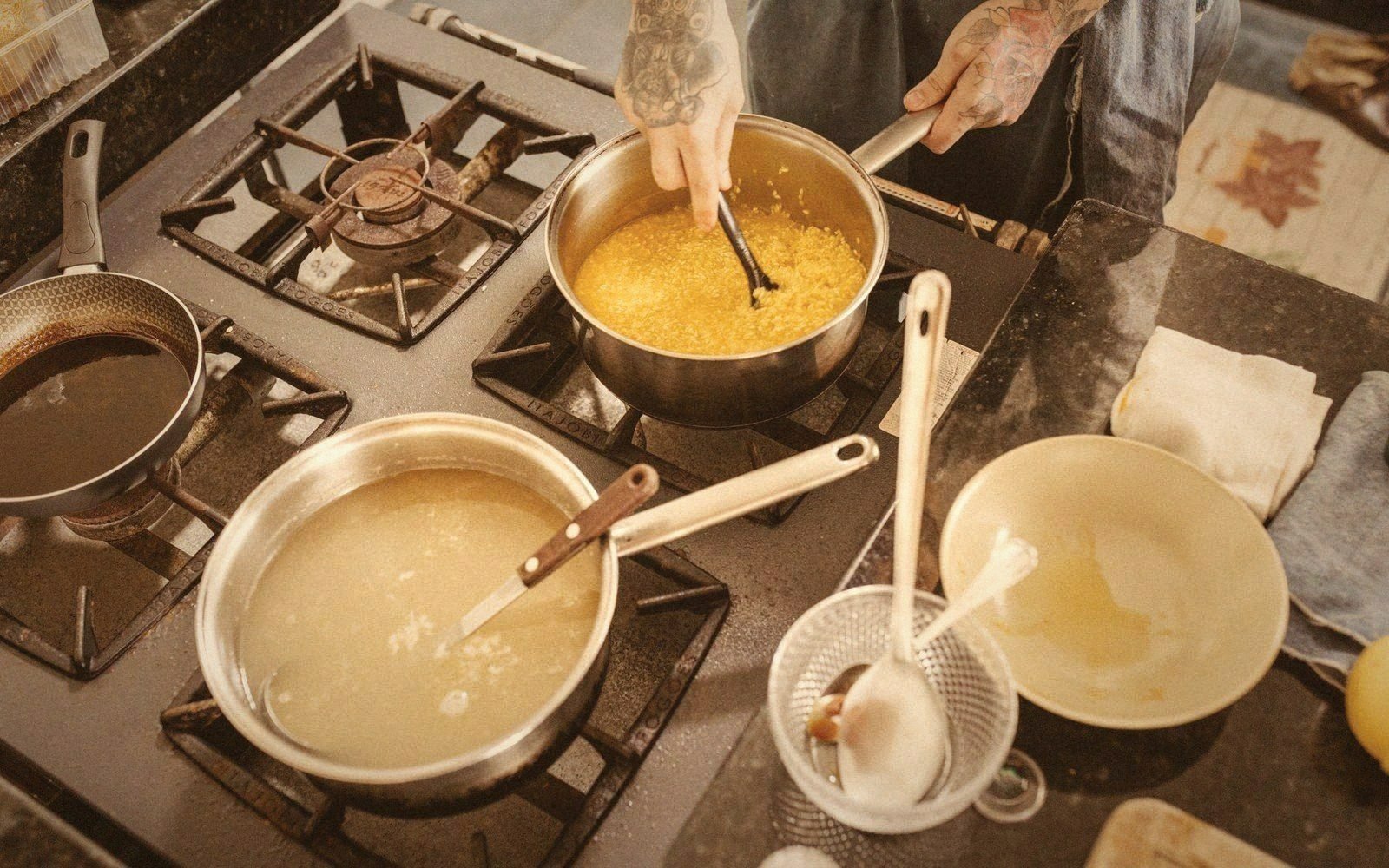
Heat, Liquid and the Lid
The first decision is browning. Searing the meat in a little fat before adding any liquid is not strictly mandatory, but it builds colour on the exterior through the Maillard reaction — the browning of proteins and sugars at temperatures above roughly 140 °C — which adds depth and a faint bitterness that counters the richness to come. Do it properly: dry the surface, get the pan genuinely hot, and do not crowd the pieces. Steam is the enemy of a crust.
Once the meat is coloured, you deglaze, add aromatics and pour in enough liquid to come between a third and halfway up the meat — never to cover it. Full submersion boils rather than braises; the meat tightens and the liquid stays thin. You want a covered environment that holds the braising level just below a simmer, roughly 85–90 °C, so that collagen converts without the muscle fibres seizing beyond salvation. This is where the lid matters: on, and the liquid circulates in a closed loop; off, and it reduces and concentrates; ajar, somewhere between.
The liquid is part of the dish. Wine, cider, stock, a combination — it reduces as the meat braises and picks up gelatine shed by the collagen, becoming the sauce without a separate thickening step. A well-braised shin leaves behind a liquid that is already a sauce; it simply needs skimming and, often, reducing slightly over a higher heat once the meat comes out.
Choosing the Cut
Beef gives you the most options: shin (also called jarret) is all collagen and connective tissue; blade (paleron) has a seam of gelatinous tissue running through its centre that turns silky when braised long; cheeks are compact and reward patience. Pork cheeks are among the most forgiving cuts in the kitchen — small, even, high in collagen, done in two hours where a beef shin might take four. Lamb shoulder outperforms leg every time it goes into a braise, because the leg is lean and the shoulder carries fat and connective tissue in proportion. Oxtail, sold in cross-sections, is almost entirely collagen and bone; its braising liquid sets hard when cold, which is the measure of a successful braise and the beginning of an excellent stock.
One thing to watch: internal temperature alone tells you nothing useful for these cuts. A beef shin at 85 °C internal temperature is not done; it needs to stay at that level long enough for the collagen to dissolve. The test is a skewer or a thin knife — it should slide in and meet no resistance, as if the meat has given up fighting. That moment, not the clock, is when you stop.
Letting the meat cool in its liquid before serving is not optional if you want the result to hold together. The gelatine re-sets slightly as the temperature drops, firming the texture. Reheat gently, and the dish is better the next day than it was the first.