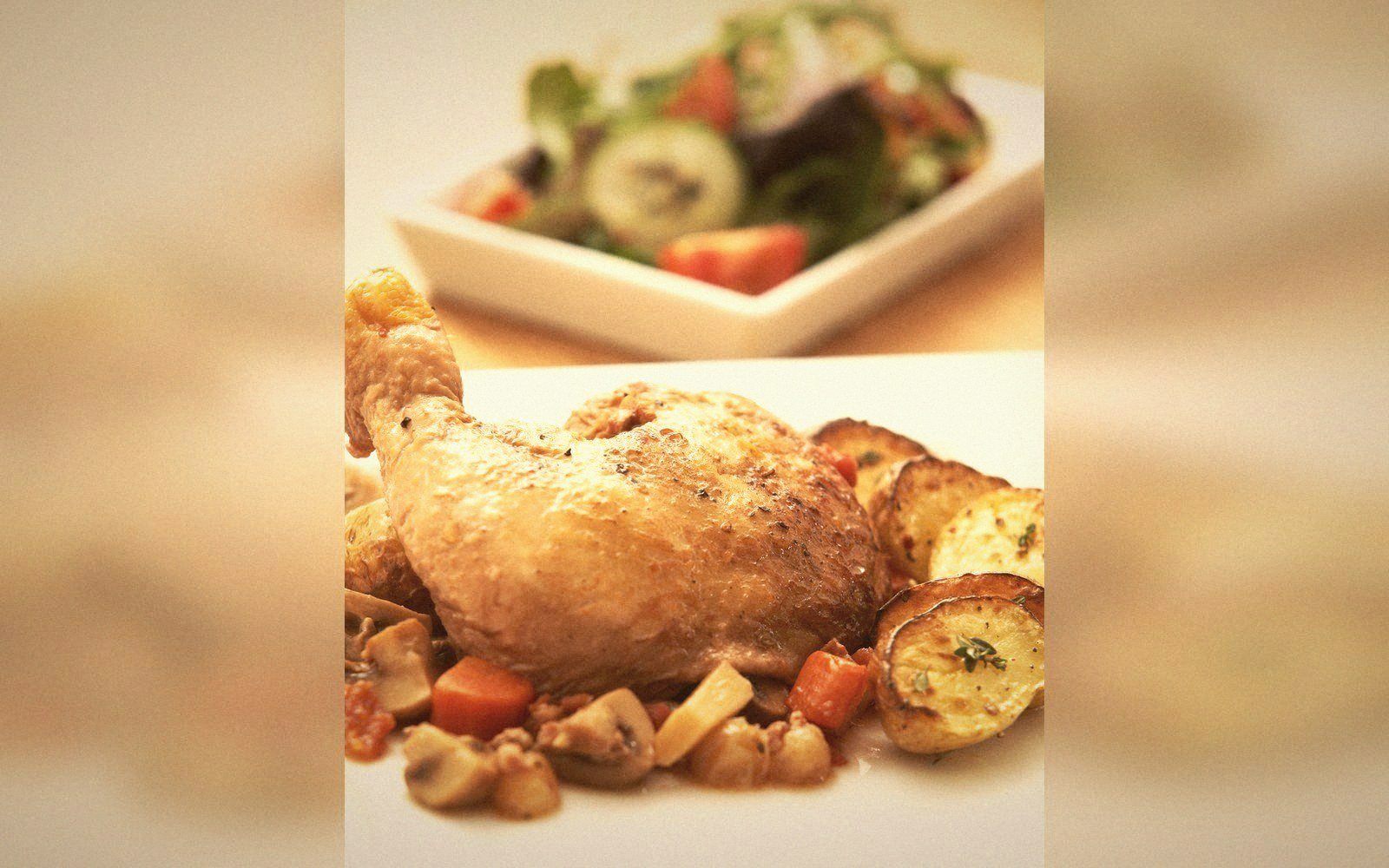
The bird comes first
Coq au vin — literally rooster in wine — is a braised dish, and it is a braised dish for a specific reason: the rooster was not edible any other way. A working cockerel, culled after years on the farm, carries muscle that no amount of roasting will tenderise. Its connective tissue needs long wet heat to convert to gelatine, and its flavour — concentrated, almost gamey — needs something equally powerful to contain it. The wine is not a flourish. It is structural.
This is why substituting a young supermarket chicken produces a softer, blander result. The dish still works, and most versions made today use precisely that, but understanding what it was built for helps you see what to push: more time, a better bird, and a wine with real structure. A modern poulet fermier, reared for twelve weeks or more and carrying some muscle tone, sits closer to the original than a six-week battery bird and rewards the full braise accordingly.
What the wine does
A good coq au vin calls for a bottle of red that is worth drinking — the old rule, and a sound one. Wine reduced by heat concentrates its acids and tannins as well as its fruit. A wine already thin and sour will become more so; one with body and dark fruit will reduce into something complex. Burgundy is the traditional choice and makes historical sense: this is very much a dish of the French interior, and Burgundy's pinot noir has the acidity to cut through fat without the tannin becoming astringent over a long braise. A robust southern French red works too. What does not work is anything labelled "cooking wine".
The bird is marinated in the wine, sometimes overnight, which begins the softening of the meat and allows the flavours to penetrate. Many modern recipes skip this step on a young chicken; on a genuinely old or free-range bird, it remains worthwhile. When the braise begins, the wine goes in with enough stock to keep the meat barely submerged — this is a braise, not a boil — and the pot lid goes on, heat kept low enough that the liquid trembles rather than bubbles. Two to three hours for a farm chicken; a real rooster needs longer, and you will know it is done when the meat yields to a probe without resistance.
The garnish is not optional
Coq au vin carries a classic garnish that is inseparable from the dish: lardons, button mushrooms and small pearl onions, each cooked separately before joining the braise at the end. The lardons — short strips of smoked or salted pork belly — are rendered until crisp, their fat used to colour the chicken pieces before the wine goes in. The mushrooms are sautéed hard in the same pan to drive off their moisture before they turn limp and pale. The pearl onions are either blanched or glazed in a little butter and stock until they are tender but intact.
This matters because adding all three raw would turn them to mush during the long braise. Cooking each element to the right stage before combining preserves their texture and their individual flavour in the finished dish. A sauce reduced from the braising liquid — strained, skimmed of fat, returned to the pot — carries all of it together. Some cooks stir in a spoonful of the chicken's blood to thicken and darken the sauce at the end, an older technique that gives the sauce a particular depth and a near-black colour. More commonly, the sauce is finished simply by reduction, or whisked with a small knob of cold butter off the heat — a quick emulsion that gives it gloss and body.
The bread served alongside — ideally a good country loaf with some crumb to absorb the sauce — is not incidental. Neither is resting the dish. Coq au vin made a day ahead and gently reheated is noticeably better than coq au vin served immediately; the gelatine that has dissolved from bones and skin into the braising liquid sets overnight, and reheating it redissolves that gel into a sauce of a richness and cohesion that no amount of last-minute reduction quite matches. Some dishes improve by waiting. This is one of them.