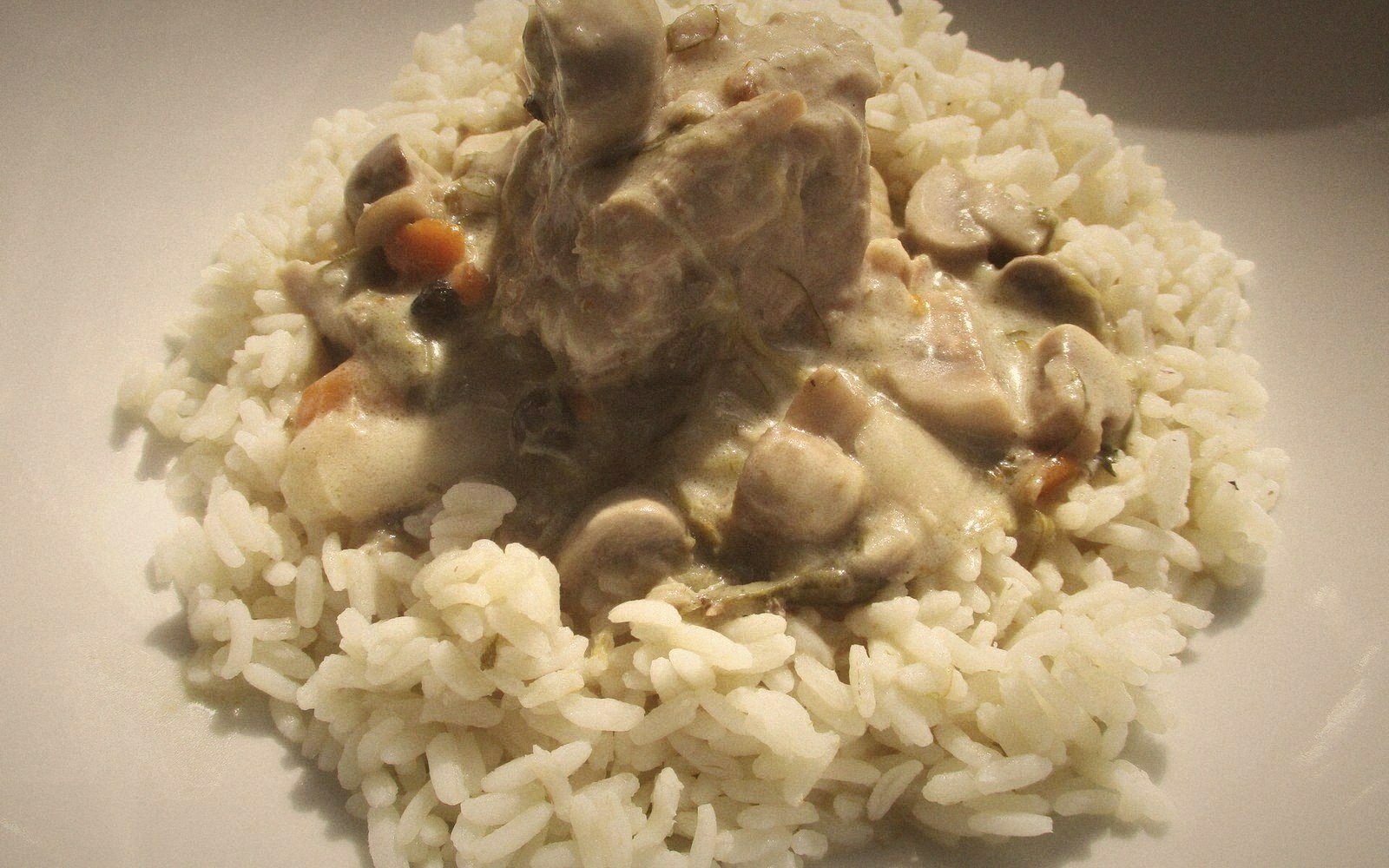
The white stew that refuses to brown
A blanquette — a white stew, derived from blanc, white — is defined by what the cook does not do. The meat never meets high heat. Nothing is seared. The fond, that brown crust that gives braises and stews their depth, is entirely absent. The point is a different kind of flavour: clean, milky, gently savoury, with the soft sweetness of a good veal stock and a cream sauce that is rich without being aggressive.
The technique is closer to poaching than braising. Veal shoulder or breast goes into cold water or a pale stock — cold, because you are drawing out rather than sealing in — brought slowly to a trembling heat and held there. A noisy boil would tighten the proteins and cloud the liquid. What you want at the end of an hour and a half is a broth that is almost clear and meat that has given up its gelatine without turning to shreds.
That broth does double duty. Once the meat is tender, it becomes the base for the sauce: a roux of flour and butter, blond rather than dark, enriched at the finish with a liaison of egg yolk and cream. The liaison thickens without further heat — it will scramble if you boil it — and gives the sauce its characteristic velvet. A squeeze of lemon at the end is not optional; without it, the richness has nowhere to go.
The garnish in a classical blanquette de veau — veal blanquette — is pearl onions and button mushrooms, both cooked separately and both kept pale. Colour anywhere in the dish is a small failure of attention. This is not timidity; it is a set of genuine decisions, repeated deliberately, about what the dish is supposed to taste like.
What makes it worth understanding is that the absence of browning is also an absence of bitterness, of smoke, of the caramelised edge that comes with a sear. The flavour sits in a narrower, cleaner register. For a home cook, that register is harder to hit than it sounds: colour is easy to prevent, but the richness, the binding, the acidity — those take practice to balance.