The pig that had to last
A farm pig, slaughtered in late autumn once the cold had set in, weighed several hundred kilograms. The family could not eat it before it spoiled. They had no refrigerator. What they had was salt, fat, smoke, fermentation and patience — and from those five tools came every item you will find on a charcuterie board today.
This is not a romantic reading of the past. It is the literal explanation for why each product looks and tastes the way it does. Keep the preservation logic in view and the flavour suddenly makes sense: the sharp salt hit of a jambon cru (dry-cured raw ham), the slick fat in a rillette, the acid tang in a dry sausage, the smoke on a Morteau. Each of these is the flavour of a method, not an addition made for pleasure.

Salt does most of the work
Salt is the foundation. It pulls moisture out of meat through osmosis and lowers the water activity to a level where dangerous bacteria cannot multiply. Pack a leg tightly in salt for long enough — six weeks, in the case of a jambon de Bayonne, with a controlled rubbing-in over several days — and you have halted the biology that would otherwise ruin the meat. After that, hanging in cool, moving air does the slow drying that turns a cured leg into something that will keep for a year or more.
Saucisson sec — dry-cured sausage — runs on the same principle, but adds a second layer: fermentation. The lactic-acid bacteria present on the meat and the casing drop the internal pH as the sausage dries, creating an environment hostile to pathogens. The white bloom on the outside is mould, selected and managed, forming a permeable skin that lets moisture out while keeping oxygen exchange at the right rate. That bloom is not decorative. It is part of the mechanism.
Fat is the other great preservative, and it works by exclusion rather than chemistry. Rillettes — pork cooked long and slow in its own fat, then potted with a seal of solidified fat on top — keep because air, and the bacteria it carries, cannot reach the meat. The same logic governs a confit: hold the meat below the fat's surface and nothing can touch it. Both methods make sense of the result on the palate; that richness is the medium of preservation, not an accident.

Smoke and the sausage of the east
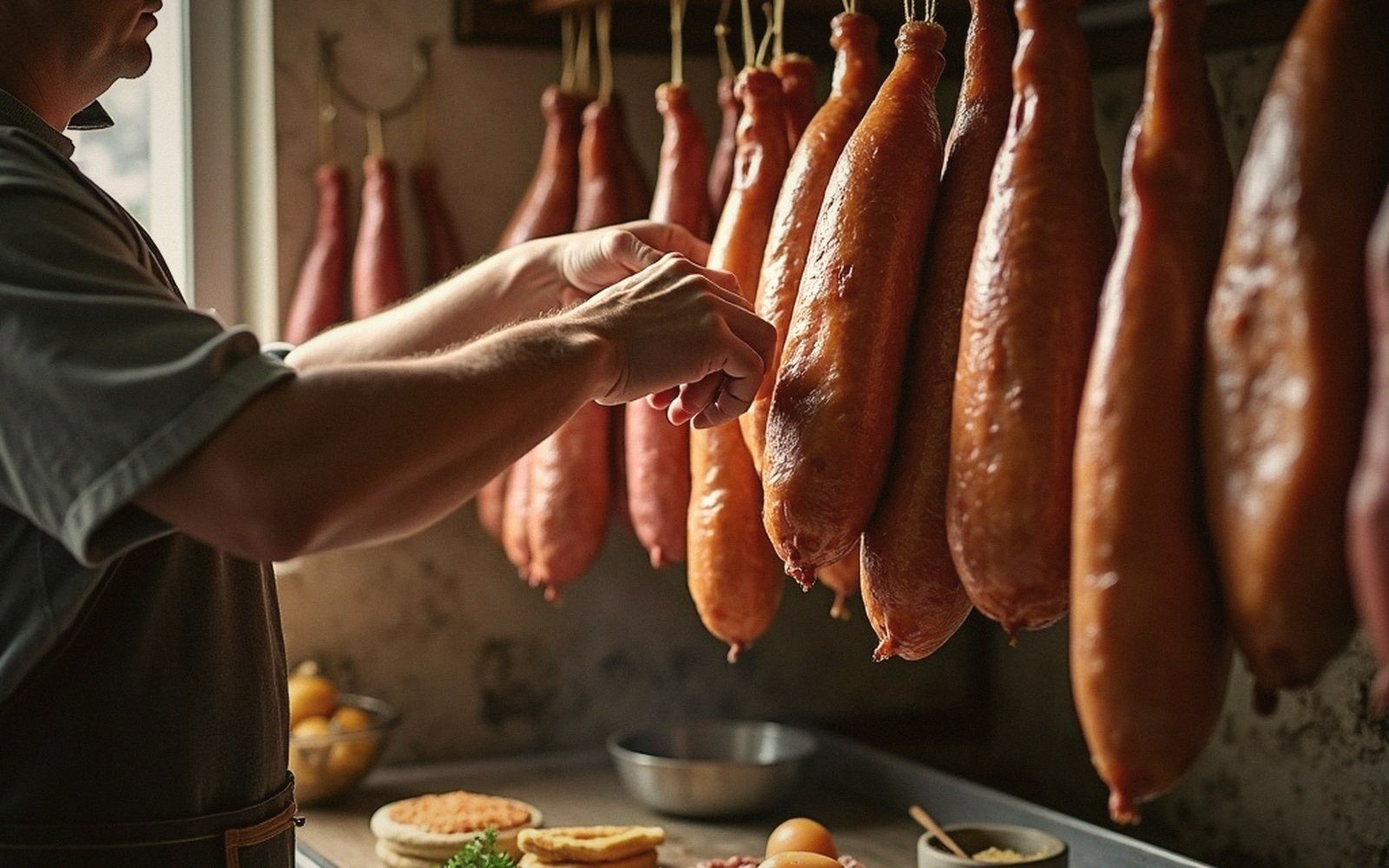
Smoke works through a combination of drying and the deposition of antimicrobial compounds — phenols, aldehydes — on the surface of the meat. It was especially important in the wetter climates of the north and east, where cold air alone was not dry enough to cure reliably. The saucisse de Morteau, from the Franche-Comté, is still smoked in a tuyé, a broad pyramid-shaped chimney built above the hearth, using pine or fir and juniper. The IGP (Indication Géographique Protégée) that governs it today is, in effect, a codification of the original preservation conditions — the specific wood, the altitude, the duration — because those conditions produced the specific character the method required.
In Alsace, the smoking tradition runs even deeper, shaped by proximity to Germany and the abundant oak and beechwood forests nearby. Knack (a poached, lightly smoked sausage), lard fumé (smoked bacon) and smoked ham appear across the region in ways that have no real parallel in the south, where drying conditions are better and fire-curing unnecessary.
What the board tells you
Look at a board assembled from different regions and you are reading a map of different preservation problems. The dry, wind-scoured uplands of the Auvergne gave the world saucisson d'Auvergne. The wet Atlantic winters of the Basque country produced the heavily salted Bayonne. Alsace smokes; Provence and the south dry in the sun and the tramontane. The climate wrote the recipe long before anyone thought of a recipe.
Understanding this does not change how a board tastes. But it does explain why, when you buy charcuterie at a market rather than a supermarket, you are buying something made by someone who still knows what the method is for.