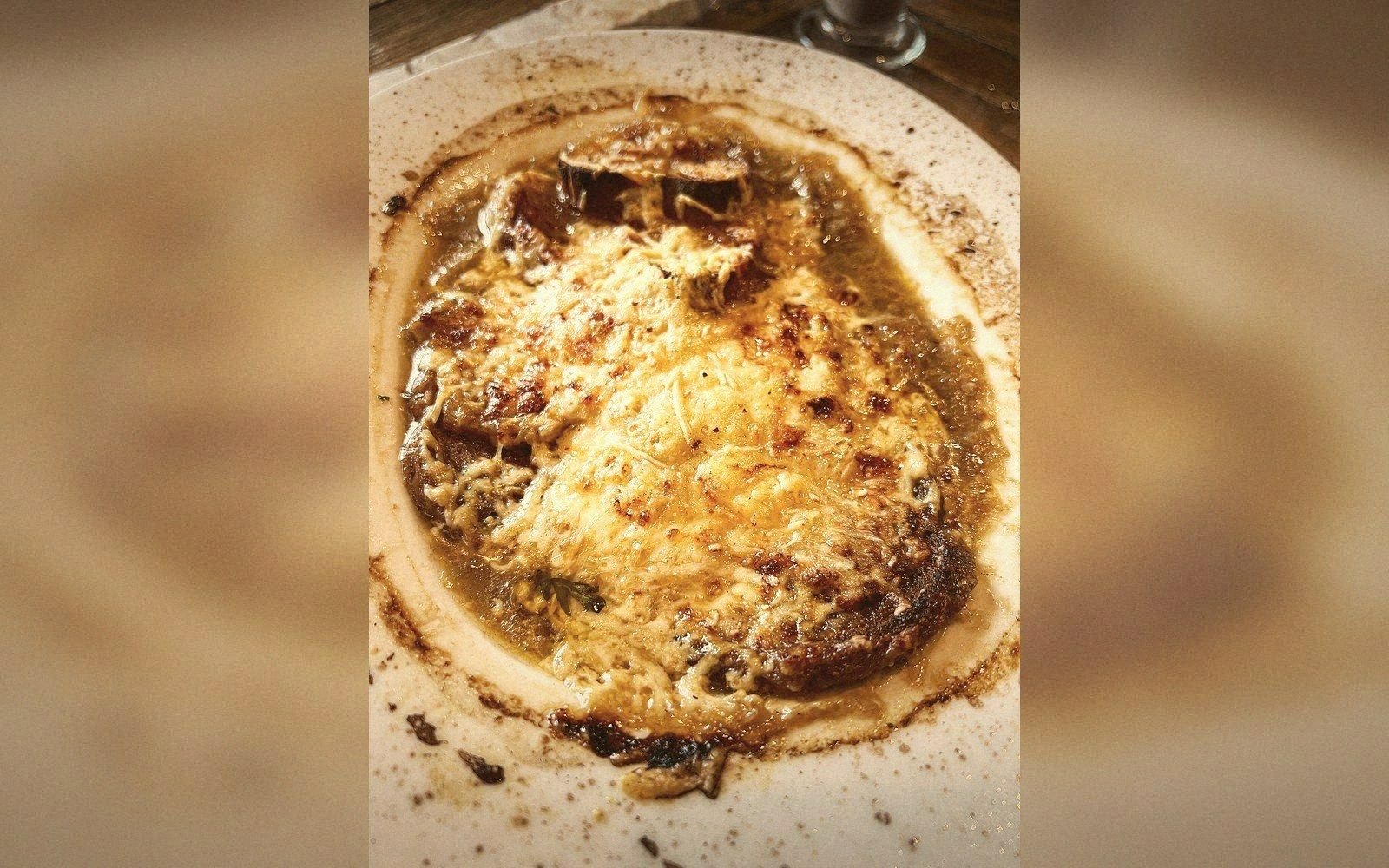
Forty minutes of patience
The onions go in first, and nothing else happens for a long time. That interval — low heat, a heavy pan, a wooden spoon used every few minutes — is the dish. Everything that follows is secondary.
Soupe à l'oignon gratinée, the version most people know, is a peasant preparation that became a Parisian institution, associated with the market halls of Les Halles before their demolition in the 1970s. Traders and late-night revellers ate it at dawn at the surrounding brasseries. The dish's reputation for restorative power is cultural memory, not chemistry; what it actually offers is sweetness, depth and a crust of bread and melted cheese that turns a thin broth into a complete thing.
The sweetness is everything, and it comes only from time. Onions are about eighty-five percent water and loaded with fructose. Cut them, apply gentle heat, and the water begins to leave; keep the heat low enough that the base of the pan never scorches, and the sugars concentrate and caramelise slowly through a sequence of reactions that produce hundreds of flavour compounds. Turn the heat up to hurry it and you get bitter patches and an acrid smell. The colour should travel from white to translucent to pale gold to a deep, even amber. Forty minutes is a minimum; an hour is not unusual. A knob of butter with a little neutral oil — the butter for flavour, the oil to raise the smoke point — is the standard fat. Some cooks add a pinch of sugar at the halfway point; this is legitimate, but it admits that the heat was too high.
Deglaze with white wine or a splash of dry sherry once the onions are properly dark, scraping up whatever has caught on the pan. Then the stock. Beef stock is traditional and gives the darkest, most savoury result, but a good chicken stock works and a careful vegetable stock — one built on roasted alliums and a little dried mushroom — is surprisingly close. What the stock must be is real: a thin, pale, shop-bought liquid undoes everything the onions achieved. The soup simmers for twenty minutes, no more, because the work is already done.
Ladle it into oven-safe bowls, lay a slice of stale bread on the surface, cover it entirely with grated Gruyère or Comté, and put it under a hot grill. The cheese must bubble and mottle before you pull it. The bread is not garnish — it absorbs the soup from below and holds the crust from above, and eating through it is the point of the dish.